What is a fatigue programme?

Our goal is to help people manage their energy before it becomes a problem.
Many factors contribute to or cause fatigue and our role is to support clients:
manage their energy
remain at work
return to work
improve their overall health and wellbeing.
How do we do this?
Our clinicians carry out a comprehensive assessment on the impact of fatigue across all areas of work and life. We then develop a bespoke programme which supports the energy goals of both the employer and employee to deliver sustainable improvements using rehabilitation and return to work strategies.
The PEO Model
We use the Person, Environment and Occupation (PEO) Model (Law et al 1996), which helps us determine the relationship between a person’s health, energy and their work activities. Our programmes look at the following:
Work role, responsibilities and requirements
Sleep
Movement and exercise
Activities of daily living
Mood
Beliefs and anxieties
Hobbies and leisure
Social and relational
Environmental
Nutrition.
Dual Training
As a profession occupational therapists are trained across both physical and mental health focusing on occupation. We apply this to our clients helping them identify and manage low energy and fatigue which can make all the difference with:
engagement
a sustainable return to work and
improving outcomes across work and home.
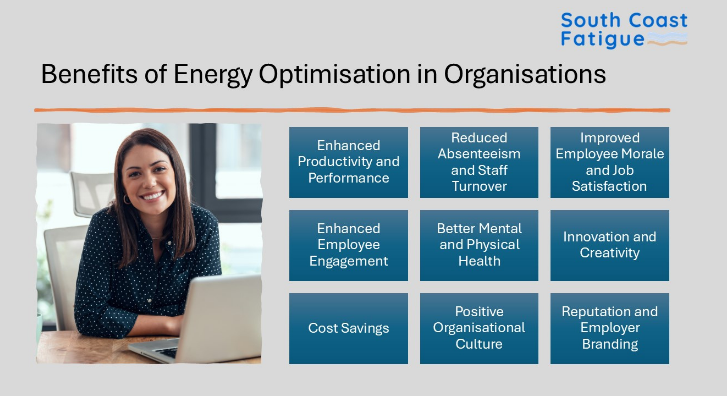
As you can see from the slide below, which we presented at one of our recent lunch and learn sessions, stabilising energy can have significant benefits both for the employer and the employee.